Saturday, July 23, 2011

Flowers--lavendar wands

I have three rose bushes in the front yard. Here is a small bouquet of my white roses. I love the way the crystal in the window puts a rainbow on this arrangement.

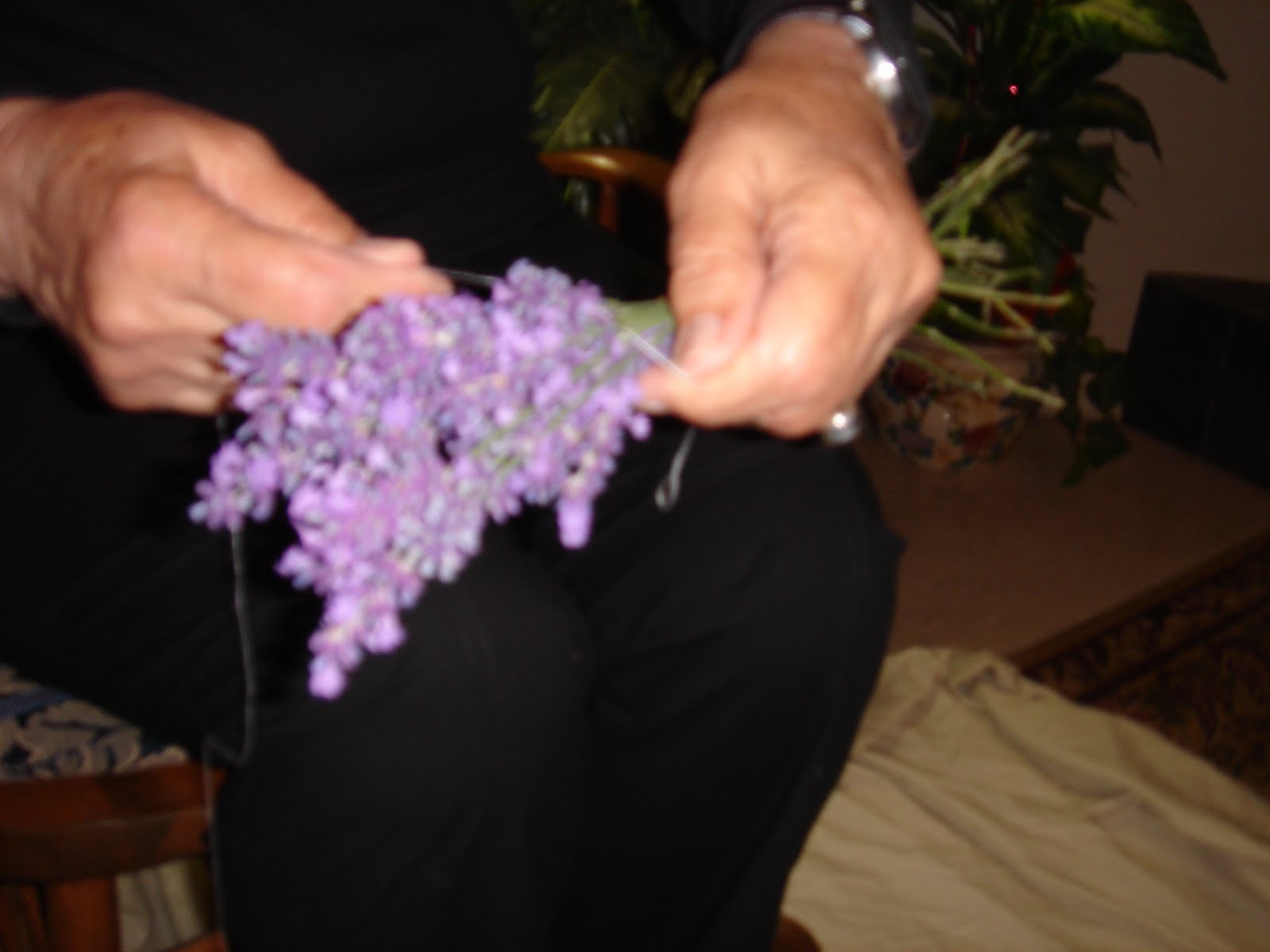
The first owners of my house put in a healthy grouping of lavendar, for it’s beauty, scent and to help reduce aphids on the roses. As far as I can tell there are two varieties. The deep purple is the Buena Vista. It blooms earlier. The second is lavendula lanata, I believe. The bumblebees really like the flowers as well as the honeybees. they let lme know when it is time to make lavender wands.

They take about an hour to make each, so I only make them for family and friends. They are wonderful to enjoy during the cold winter months.


Tuesday, July 5, 2011

Recital and a fiber discovery


On July 1, 2011 Janita and I had the pleasure of attending our shared Grand daughters’ recital with their parents.

After the recital we went to a lovely Gresham Lebanese Restaurant. As we came out Janita and I saw a sign reading

Andersen Fiber Works

We went in and were greeted by the owner, Jen Andersen.

Here is a picture of the entrance.

Here is Kathy who gave us lessons on drop spindles.


Anderson Fiber Works is at

20 NW 3rd St.

Gresham, OR 97030…Telephone 503-667-6852 or 503-492-6652

www.hanksinthehood.com or e-mail her at

jen@hanksinthehood.com They have only been open for a month. We felt the store was inviting and well lighted with natural light. They even had a delightful children’s area. This store has more fiber for spinning, though they do invite knitters and have some yarn.

Well this all impelled me to get my completed shawl blocked. I had been knitting this for some time. Used two patterns from Knitting Lace Triangles by Evelyn A. Clark a designer who lives in the Pacific Northwest. www.fibertrends.com The yarn was purchased three or fur years ago when Janita and I attended a market at the Oregon Convention Center in Portland. We were with Betsy. We got an amazing price on this mohair yarn at the booth of Russ Groft, formerly of McMinnville’s Robin and Russ. The store is closed and Russ has passed on, so this shawl is a memory of him.

I just reinstalled (moved) my clothesline because the shed and chickens have occupied the former drying yard.

Monday, June 27, 2011

Nanci's Cantalope and other interesting things


Jeannie Berg found out about Pike melons. This is a cantaloupe developed for the Willamette Valley by Oregon State University many years ago. It fell out of use as is has no shelf life. It will spoil within two days after picking and it must be picked ripe.

She researched and found that the seeds for this delicious melon were available from a supplier in South Carolina. Early in 2011 Jeannie was featured in an article in the Statesman Journal and she talked about the seeds.

A few weeks later she received a two single-spaced hand typed letter from a gentleman who lived here in Salem, had developed the melon with Pike and had been growing the melons for years and saving the precious seeds. He sent her 2 pounds of his seeds with directions on growing them successfully here in the Valley.

Jeannie started seeds in her green house and when the warmer weather finally came to the valley she planted starts on her farm. Once they have grown Jeannie will have some melons for sale at the Salem Farmers Market http://www.salemsaturdaymarket.com/ or at

the Independence Market http://www.ci.independence.or.us/AboutIndependence/IndependenceFarmersMarket/

later this summer. Those lucky people that have one of Jeannie’s CSA shares will get some also.

Today Jeannie is planting two here in my garden.

We put egg shell pieces around the plants to retard slugs and compost from the composter for additional nutrients.

Earlier this Spring we folded wax paper hats for the Pike Melon exactly as suggested by our local mentor.


I am looking forward to a good melon or more. I am hoping for melons like one grown by my father in Illinois.

Janita’s seed ball…Janita gave me one of her seed balls, a gift from one of her SLP’s. Here is the result, so far. June 27.

In other garden news I have a very small tomato given to me by a co-worker, Amy. She got this from the Salem Harvest group. I was attracted to the purple leaves. Both Jeannie and Jayme (the tomato expert) explained that this was due to a lack of magnesium. The fix was to put a teaspoon of Epsom salts in a quart of water and “feed” it to the plant.

Two doses and I no longer have purple leaves, but a happy plant.


Saturday, June 4, 2011

end of May Bees...zz.zz

End of May…Bee report.

This sign was a gift to the bees from Betsy Bailey. It is along the fence where Jeannie Berg has planted the insect hedge (local flowering plants for the season). Continuing along there is the hive. This is a cedar Top Bar hive from http://www.beethinking.com/ . I was able to pick mine up in Wilsonville. I love this hive because it smells good and I can see the bees everyday.

I got a bench to put next to the fence so one can sit and watch them with the door open. I am sure it will not be long before I am out there knitting with the bees.

Well a bad thing happened about a week ago. My house had been pressure washed and the eves painted. That part is good as the house looks great (Ed Carlson – 503 390. 2579). When they washed and painted they misplaced all of the yellow jackets, hornets and wasps that had taken up living in the eves of the house. That too is good, BUT the yellow jackets decided the sugar water in the beehive was fair ground and they moved in…the bees didn’t care they were busy building comb, getting honey and raising brood. In fact they usually don’t care if I open the hive or if I am in their way as they leave and return for nectar. But I noticed through the observation window that they were going through sugar water (1 cup sugar to 1 cup water blended). So I came to replace the water and I was “greeted” by upset insects. One flew up and got caught in my shirtsleeve under the arm. (You are right not one of the honeybees, but a yellow jacket). The sting did not bother me at the time, but as Janita will tell you I was affected…later that day. The next morning I woke with horrible joint pain and a headache. It was not until that afternoon that I noticed itching at the sting site and there was a welt and infection spreading about 4 inches from the site.

Honeybees will not leave an infection. Their stinger is barbed and it comes out along with their intestines when they sting. This means if they do need to sting to defend the hive they will not bring back germs or other things to the hive. A part of the reason all honey is pure and clean.

I definitely had an infection, but was able to fight it off and did not need antibiotics. I will have epinephrine on hand from now on as a precaution. I am well, but wanted to give the honeybees more room in the hive by removing the sugar water jar to give them more room to draw comb. They have taken care of the yellow jackets, which are not longer there and they are back to their business, not at all bothered by my opening the hive and getting the jar out.

Today when Jeannie and I looked in the observation window, we noticed what appears to be a queen cell or two. I am hoping that the extra room will help in keeping them from swarming.

It is so much fun to see and work the bees. No honey until next spring after they have wintered over.

Bees are very busy as we are now in “nectar flow” season. They were in the raspberries, strawberries and even enjoying a blooming cabbage in the garden. They have lavender coming on and then roses and then their insect hedge will begin blooming. The yard was actually a buzz with happiness. (Sweet as honey)

Wednesday, May 11, 2011

the "farm" garden 5/9/11

Here are the chickens. Audrey and Phyllis are the Banty Cochins’ in the front and Alabaster the biggest chicken is in the back. You can’t see Amethyst well. Amethyst and Alabaster are Americana’s. All four are laying hens. Audrey just started laying.

Here is a picture of the “orchard”. It is a small raised bed about 6X4 feet. The blooming trees are the apple espalier trees. There are four kinds of apples on each. The other espalier trees are the pear trees with bartlet and Anjou pears on each. In the center are two columnar apple trees. This is the second year for them.

The Pear trees have a problem. The red spots on the leaves are not good. Jeannie is not certain if this is a virus, mite, or fungus. We are guessing fungus, as it has been such a wet spring. So today we sprayed with Safer, which is for fungus and mite. We used a shield as we sprayed to insure that no spray got on the apple blooms. We don’t want the bees to be at risk.

I went into the beehive and removed the empty sugar water feeder. The bees seem happy. They are flying more as the days become longer. We could see some sealed cells through the observation window.

The peas, planted in Dec. 2010 are in bloom.

We planted two more tomato plants. Juan Flame, which is the favorite of local chef’s and the author of the Heirloom tomato book. When she was asked if she could have a field on only one tomato which would it be. Is what she would choose. Purple lalabaugh is Jamie’s favorite, people love this one and come up to the stand just to smell then buy.

We added some fava bean to the insect hedge, which has lots of tiny shoots. We planted seeds for tombocini and yellow zucchini and butternut squash. We planted some celery plants and some yellow cauliflower.

Saturday, May 7, 2011

Quick solar panel tour

It is May 4, 2011 and the best solar day to date. It is 6 pm. We are facing North and the panels are facing due South. As you can see the house is shaded by the tree on the West. The sun's angle to the horizon is at 60 degrees. In the winter the tree shades the panels in the late afternoon as the sun angle is less. In the Summer the angle is greater and solar collection improves. Savings per month averages about $80.
As you can see there are 20- 3 foot by 5 foot photo-voltaic panels. Even though Oregon is well known for having many rainy days it is still considered a good solar energy location. The panels do work through out the year even in rain (just not nearly as much as would be desired).
This is the side of the house where the energy collected is sent to the solar converter, located on the inside of the garage. Each panel is a 190 watt panel or 3800 watts total.
This is the outside gage which is read by the Power company. When I had the older wheel, I delighted in coming out to see the wheel going backwards meaning I was making the electric energy. All of the power goes into the electric power grid. I get my bill each month along with a letter telling me how many Kilowatts of energy the panel. My bill is usually lower than my neighbors. During the Summer when air conditioning in needed my bill does not go up.
In the garage, on the left is my breaker box, next the solar power collector (on/off) switch. You can see the tube at the left top of the box bringing the power in from the panels. The large silver and blue box (Fronius IG) in the middle converts the energy. Finally the right gage tells how much power is being made.

Monday, May 2, 2011

Visit from Your HOme Harvests 5/2/11

The mason bee house. The robin nest on top is not being used so far this year. The tubes on the shelf under the green roof are new. You can see one entering (hopefully with an egg) The tubes below, some of them sealed off are not clean this year and not viable, but I will clean them for next year as they are clear and we can see the bee's development in the clear tubes inside.
The blueberry flowers in front, the peas to the back and left planted 12/10 and 18 in tall, and the tiny carrot sprouts to the right and back planted about 3 weeks ago are 1 inch high.
We are concerned about the espalier pears. They have a mite. Jeannie is choosing a safe spray.
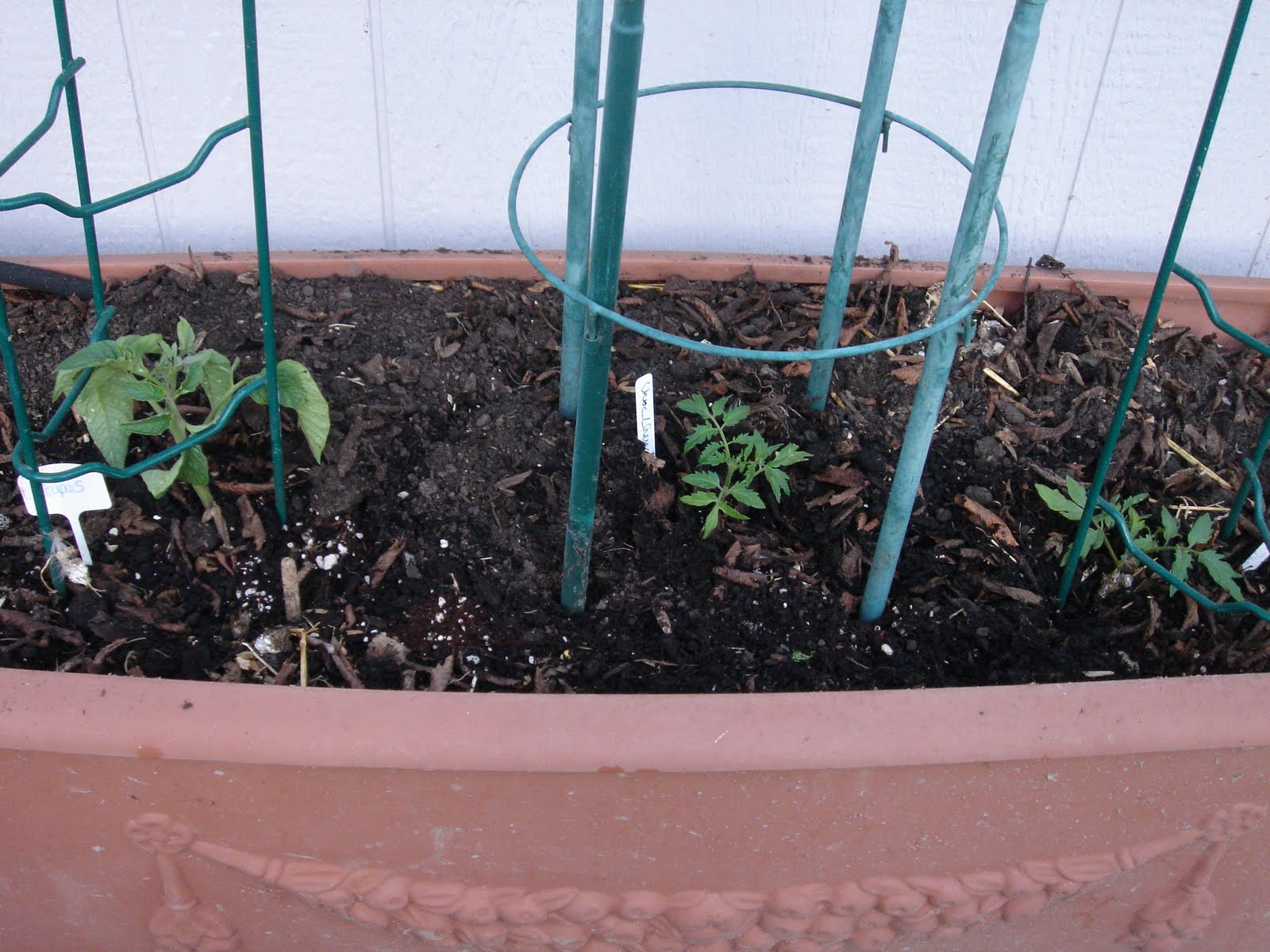
We planted tomatoes - Stupus my pick because I am supposed to have tomatoes in July- Chocolate Cherry (evaluated by an 8 yr. old last summer as "almost as good as ice cream")- Eva Purple - Jeannie likes this as it has someone's name.
Behind the fencing are new seedlings. These are native plants/weeds that will flower all summer for the bees "delight".
Next we check the bees. their sugar water is to the left. They have used 1/2 a pint. They are gettingmore from the environment.
First we always check the chickens. Here is Amathest. She is the lead chicken.
The chickens are now laying 2-3 eggs a day.